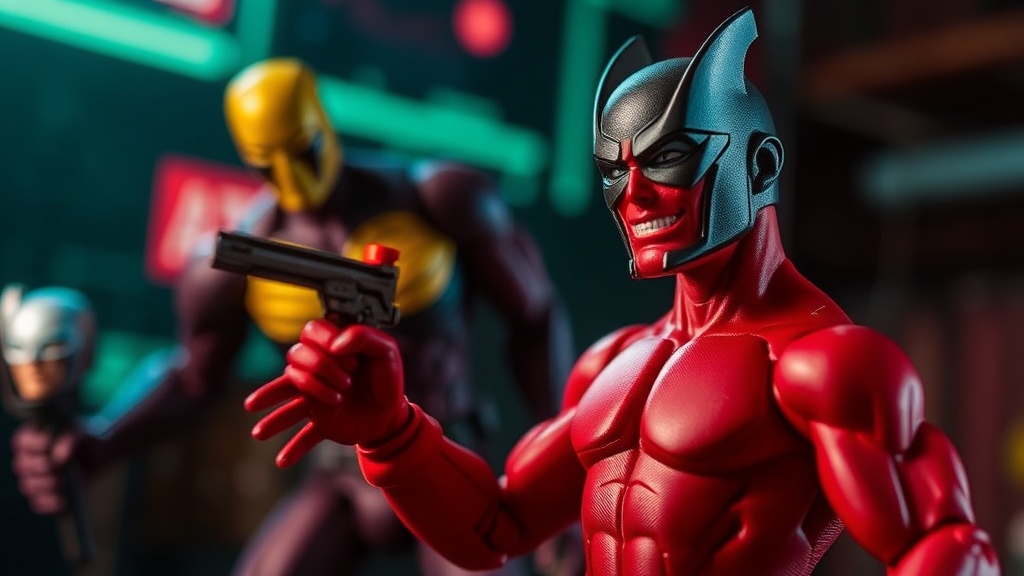
Beyond the Box: Pushing the Limits of Your McFarlane Figure's Articulation

You’ve just unboxed a fantastic new McFarlane figure — perhaps a detailed Dark Knight or a formidable Space Marine — and the first thing you want to do is set it in a dynamic pose that captures its essence. Yet, sometimes, achieving that perfect, dramatic stance feels like a puzzle. Understanding how McFarlane figures are engineered for movement, and how to safely manipulate their articulation, transforms a static collectible into a vibrant display piece. This guide explores the nuances of McFarlane's design philosophy, offering practical advice for maximizing your figures’ posing potential without causing damage.
McFarlane Toys consistently pushes boundaries in sculpt detail and character interpretation, often with unique approaches to articulation that differ from other toy lines. While some figures boast an astonishing range of motion, others prioritize aesthetic fidelity, leading to sculpt-impeded joints. Recognizing these design choices is key to successful posing. It’s not just about bending a limb; it’s about understanding the interplay between the sculpt, the joints, and the desired visual impact.
What Makes McFarlane Figure Articulation Distinct?
McFarlane figures are renowned for their intricate sculpts, often capturing characters in mid-action or with dramatic flair. This commitment to detailed aesthetics sometimes influences the choice and placement of articulation points. Unlike some lines that might favor universal articulation schemes, McFarlane often tailors the joint systems to suit a specific character's design and intended look. This means a figure’s articulation can vary significantly even within the same wave or series. You might find innovative double-jointed knees on one figure, while another relies on a more limited cut joint in the bicep, all dictated by the character’s physique and costume design.
Many McFarlane figures use a blend of hinge, swivel, and ball joints—sometimes even disc-hinges—to offer a broad range of movement. The “Megafig” line, for example, often features additional engineering to support larger sizes and heavier accessories, ensuring stability in dynamic poses. Understanding this variety is the first step toward unlocking a figure’s full potential. Don't assume every figure will move the same way; approach each one with a fresh eye, gently testing its limits before committing to a pose.
How Can You Safely Loosen Stiff Joints on a New Figure?
It’s a common scenario: you pull a figure from its packaging, and a joint feels stubbornly stiff. Forcing it can lead to breakage, a collector’s nightmare. The best approach for freeing up a stuck or overly tight joint is often heat. Warmth helps the plastic become more pliable, allowing the joint to move more freely without undue stress.
There are a few reliable methods. A simple, safe technique involves heating water to a near-boil, then carefully dipping the affected area of the figure — for a few seconds at a time — into the hot water. Another popular method uses a hairdryer set to a low or medium heat, directed at the joint from a safe distance. Apply heat for 10-15 seconds, then gently try to articulate the joint. Repeat this process incrementally until the joint moves smoothly. For extremely stubborn joints, a silicone shock oil (often used for RC cars) can be sparingly applied to the joint itself after heating, providing a lubricant that helps with long-term movement. Always exercise caution with heat sources and avoid overheating the plastic, which could warp or damage the figure’s paint.
What Techniques Create the Most Dynamic Display Poses?
Achieving a truly dynamic pose goes beyond simply bending limbs. It involves a thoughtful consideration of balance, gravity, and the character's personality. Think about how the character would genuinely move or react in a given situation. A fighting pose, for instance, should show tension, weight distribution, and a sense of imminent action. Consider using a clear display stand — many McFarlane figures include one — to facilitate airborne or leaping poses that would otherwise be impossible.
Look at reference material. Comic book art, movie stills, and even real-world anatomy can provide inspiration for compelling poses. Pay attention to the line of action — an imaginary curve that runs through the figure, guiding the viewer's eye and conveying energy. Exaggerate slightly where appropriate to enhance visual interest. For instance, a figure leaning into a punch should have its body angled, its opposing arm drawn back, and perhaps a subtle tilt to its head. Small details, like the tilt of a head or the angle of a wrist, can add immense character to a pose.
Beyond that, consider the figure’s accessories. Weapons, capes, or interchangeable hands aren't just add-ons; they're integral to the narrative of the pose. A cape billowing behind a figure creates a powerful sense of motion, while a weapon held dynamically suggests readiness for combat. Experiment with different hand gestures and weapon placements to find the most impactful configuration. Remember, patience is key. The perfect pose often takes several attempts and minor adjustments to get just right. Don’t hesitate to put the figure down and return to it later with fresh eyes if you’re struggling. Sometimes, a short break makes all the difference in seeing a new possibility.
For more detailed insights on figure posing and photography, reputable online communities like