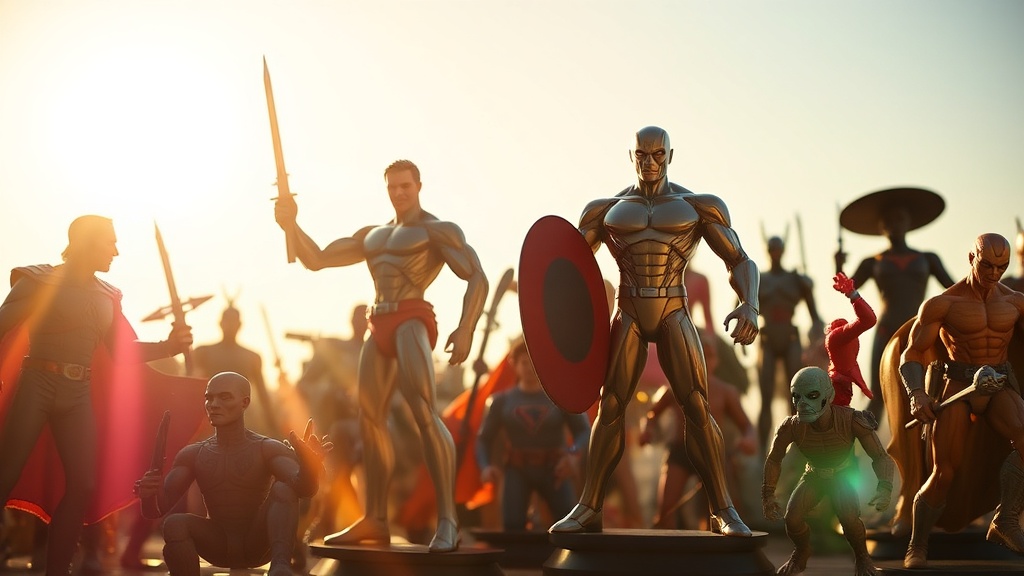
Why Sunlight Destroys Your Figure Collection Faster Than You Think

The Hidden Cost of Natural Light
Many collectors believe that a well-lit room is the best way to show off a new acquisition, but they're often wrong. Sunlight isn't just a light source; it's a slow-acting chemical reactant. While a bright, sunny room looks great on Instagram, that constant exposure to UV rays acts as a silent thief, stripping color from plastic and making articulated joints brittle. Understanding the physics of light exposure is the difference between a shelf that looks fresh for a decade and one that looks faded in two years.
When we talk about light damage, we aren't just talking about the obvious "fading" of a superhero's cape. We're talking about the chemical breakdown of polymers. Most high-quality figures, including many premium sculpts, use specific plastic blends that react to ultraviolet light. This reaction can cause a phenomenon known as photodegradation. If you've ever noticed a white figure turning a sickly yellow or a dark cape losing its deep pigment, you've seen this in action. It isn't just surface-level; it's a structural change in the material itself.
How Do UV Rays Affect Figure Plastic?
UV radiation carries enough energy to break the chemical bonds within the polymers used in toy manufacturing. This is especially true for PVC (Polyvinyl Chloride) and ABS (Acrylonitrile Butadiene Styrene). When these bonds break, the material changes. You might notice the plastic becoming much more brittle (which is a nightmare for articulation) or even feeling slightly tacky to the touch. This isn't just an aesthetic issue; it's a physical degradation of the collectible's integrity.
- Color Fading: The most common sign. Pigments lose their vibrancy as light breaks down the colored molecules.
- Yellowing: Often seen in white or light-colored figures. This is a chemical reaction called oxidation, accelerated by light.
- Brittleness: The loss of plasticizers makes the material snap rather than bend.
If you want to track the actual scientific data on how light affects polymers, the ScienceDirect database offers deep technical studies on material science and light degradation. It's a heavy read, but it proves that light damage is a measurable physical reality, not just a collector's myth.
Can LED Lights Replace Natural Sunlight?
The good news is that not all light is created equal. While the sun is a powerhouse of UV radiation, most modern indoor LED lighting is much safer for your collection. However, you shouldn't assume that just because a light is "cool" or "dim" that it is safe. High-intensity LED displays can still generate heat, and heat is a secondary enemy of figure preservation. If your display case gets hot to the touch, you're cooking your plastic.
When setting up a display, consider the type of light source you're using. Standard incandescent bulbs emit a significant amount of infrared radiation (heat) and small amounts of UV. LEDs are generally much better, but you still need to be careful about placement. A display placed directly in a window—even if it's not in direct sunlight—will still receive high levels of ambient UV throughout the day. This constant bombardment is what causes the gradual shift in color and texture.
| Light Source | UV Risk | Heat Risk | Best Use Case |
|---|---|---|---|
| Direct Sunlight | Extreme | High | Never for displays |
| Incandescent | Moderate | High | Avoid for long-term |
| LED (Standard) | Low | Low | General room lighting |
| LED (Display Specific) | Minimal | Minimal | Optimal for collections |
For those looking for professional-grade lighting solutions, checking out specialized retail lighting guides like those from IKEA can help you find ways to illuminate a shelf without creating a heat trap. The goal is to provide visibility without introducing environmental stress to the figures.
Is It Possible to Reverse Figure Fading?
This is the question that haunts every collector who realizes their favorite piece has turned a shade of pale than intended. The short, disappointing answer is: no. Once the chemical structure of the plastic or the pigment has been altered by UV light, the damage is permanent. You cannot "un-fade" a figure. You can sometimes clean the surface to remove grime, but you cannot restore the original molecular state of the pigment.
The only way to mitigate this is through prevention. This means using UV-filtering films on windows, investing in display cases that feature UV-resistant acrylic or glass, and keeping your most prized pieces in controlled environments. If you're displaying a high-end figure, it shouldn't just be "on a shelf." It should be in a protected environment. A glass cabinet with UV-protected panels is a much better investment than a standard open shelf if you want your collection to remain in mint condition for years. Don't wait until the damage is done—by then, the figure's value and appearance are already compromised.